

Visit Brad Reynolds' Amazon Author Page
Discover Brad's Books on Integral Metatheory, the Integral Vision of Ken Wilber, Meta-Perennial Philosophia, and the Universal Wisdom Tradition of Humankind and the Adept-Realizers who are its foundation.


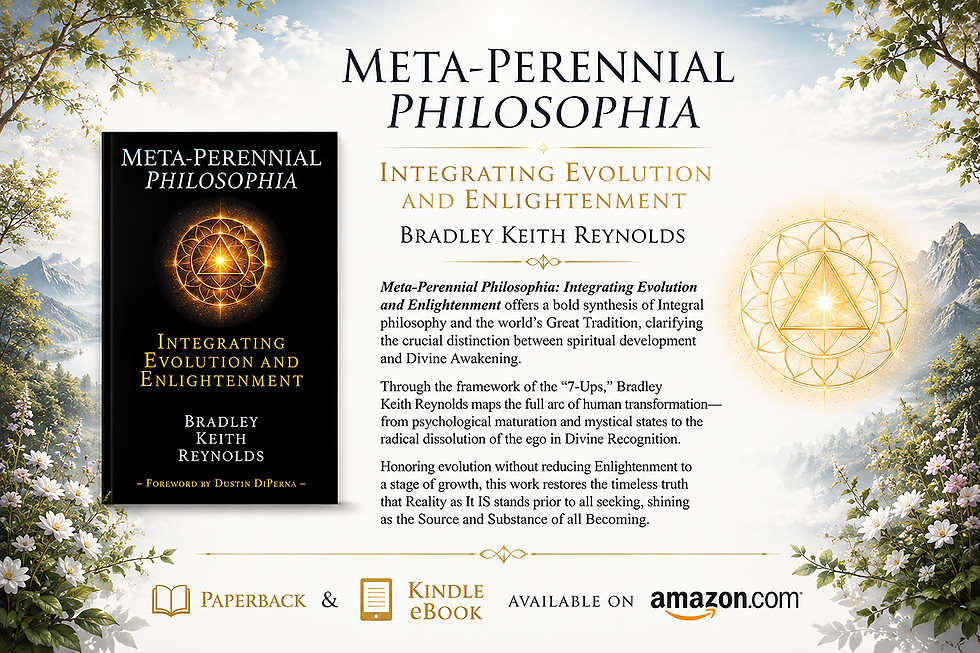
Foreword
by Dustin DiPerna
For the past three decades, I have lived inside a single, animating question: how can the timeless realizations of the world’s great contemplative traditions be shared faithfully in our contemporary world? That question first drew me to the work of Ken Wilber. Wilber’s Integral vision offered a language vast enough to hold mysticism and modernity together without reducing either. It gave me (and many others) a map of integration where few had previously existed.
Wilber’s work, and the Integral theory he helped to evolve, made explicit what had long been implicit. And spiritual realization does not occur in a vacuum but is always interpreted, expressed, and embodied through the structures available to us. Wilber’s Integral theory brought the Perennial insight forward into history, allowing Spirit to be understood not only as timeless Ground but as dynamically expressed through the Kosmos itself. For those of us committed both to awakening and to intellectual honesty, this was a profound gift. Integral theory remains one of the most important spiritual-philosophical achievements of our time.
At the same time, Wilber was always the first to note that his own theory was true but partial. That his own ideas were the first words of an integrative meta-theory, not the last words. A true wisdom culture is not a solo performance but a symphony. It unfolds through multiple voices, temperaments, emphases, and lived realizations. This is the spirit in which I read Bradley Keith Reynolds’ Meta-Perennial Philosophia.
Brad’s work does not seek to replace Integral theory. It adds another dimension. It represents another instrument entering the orchestra. Brad’s writing is tuned by his own experience, study, and contemplative life. Where Wilber’s genius lies in cartography, synthesis, and developmental architecture, Brad brings a distinct sensitivity to the ontological heart of realization itself, shaped in no small part by his sustained engagement with Adi Da Samraj and the Great Tradition of nondual Adept-Realizers.
Brad writes as someone who has lived inside the tension between evolution and enlightenment. His encounter with Adi Da impressed upon him, at an existential level, the radical immediacy of Divine Recognition, the sense that awakening is not something produced by time, growth, or complexity, but something disclosed through relationship, surrender, and recognition. In this book, Brad undertakes the difficult task of deepening integration through lived experience: asking how evolutionary and developmental insight can be held in harmony with the always-present dimension of Being.
Meta-Perennial Philosophia emerges from this lived inquiry. Throughout this book, Brad introduces a language of Two Arcs, Being and Becoming, that allow evolution and enlightenment to be heard as distinct yet inseparable movements within a single composition. Evolution gives us form, history, differentiation, and increasing complexity. Enlightenment reveals the luminous condition in which all forms arise. One does not cancel the other. Together, they offer a fuller resonance.
What I especially appreciate in this work is its refusal to flatten differences. Brad does not reduce enlightenment to psychology, nor does he dismiss development as spiritually irrelevant. He honors the full arc of human maturation while preserving the irreducible mystery of realization itself. His emphasis on Adept-Transmission, devotional surrender, and direct recognition adds a vital timbre to the Integral conversation, reminding us that spirituality is not only mapped, practiced, and enacted, but also received and transmitted.
Equally important is the philosophical seriousness of this book. Meta-Perennial Philosophia is deeply conversant with post-metaphysical thought, Big History, German Idealism, Process philosophy, and Metamodernism. It does not retreat into premodern certainty, nor does it dissolve into postmodern relativism. Instead, it gestures toward a mature synthesis in which epistemological humility attempts to coexist with ontological depth. This is no small endeavor.
I see Brad’s contribution as emblematic of what a living Integral tradition can become. Not a closed system, but an evolving conversation. Not a fixed doctrine, but a field of inquiry animated by practice, realization, and mutual illumination. As Integral theory continues to mature, it will increasingly require voices like this one; voices grounded in the lineage of awakening itself, yet fully fluent in the languages of modern thought.
Meta-Perennial Philosophia invites us to listen more carefully to the whole orchestra. To hear how development and devotion, evolution and enlightenment, structure and surrender, can sound together without being forced into unison. It reminds us that wisdom does not advance by erasing differences, but by learning how to let them harmonize.
I offer this foreword with genuine respect and enthusiasm. Bradley Keith Reynolds has added a thoughtful, rigorous, and deeply felt voice to the ongoing Integral symphony. You don’t have to agree with all of his points to read this book. What matters is the willingness to listen closely and let the inquiry deepen your own relationship to the Integral vision. Those who care about the future of spirituality, about its capacity to remain both awake and intelligent, will find in this work a beautiful addition to the melody of integral thought. You may even find yourself surprised by new levels of richness and sacredness as you read.
Dustin DiPerna
Occidental, California
2026


